
Your Story Isn't a Timeline. Here's What It Actually Is.
We're surrounded by stories. In our homes, in theaters, in our pockets. Yet despite this endless access to storytelling, many founders and business leaders struggle with a fundamental question: What is a story, really?
Is it just a sequence of events? A list of happenings strung together in chronological order? For many, the idea of crafting a story feels like a mysterious black box, something that somehow materializes through luck rather than process.
But what if it's not that mysterious at all?
What if there's actually a repeatable process that delivers consistently compelling stories?
What Is a Story?
Let's start with the basics.
At its core, a story is deceptively simple: a person or group of people who want something and have to overcome obstacles to achieve it.
Frodo wants to destroy the One Ring. Rocky wants to prove himself. Erin Brockovich wants to expose a corporation that's been poisoning people.
When you think about your own story—or your organization's story—it helps to ask the same question: What did we want? What obstacles did we have to overcome to achieve it?
If that's the 30,000-foot view, then how do you drill down deeper? How do you find the ups and downs, the tension, the satisfying conclusion that all great stories deliver?
That's where the Story Circle comes in.
The Story Circle: A Framework for Compelling Narratives
At Passenger, we often use the Story Circle, a tool developed by Dan Harmon, the creator of Community and Rick & Morty. It's essentially a refined version of the Hero's Journey, the narrative framework created by mythologist Joseph Campbell.
The Story Circle walks each character through eight steps that result in a compelling, resonant journey. Let's break each one down.
Step 1: You
Who are we talking about?
This is where you establish your protagonist. Before they embarked on their journey, what were they like? What was their comfort zone? What did the world look like from their perspective?
For a founder story, this might be: "I was working a corporate job. I had stability. I had a 401k. But something was missing."
The goal here is to make your audience understand who this person was before the transformation.
Step 2: Want
What did they want?
This step goes beyond surface-level goals. Yes, they wanted to start a business. Yes, they wanted to grow revenue. But go deeper.
What did they want emotionally?
Were they seeking acceptance? Independence? The chance to prove something? Were they running from fear, or running toward hope?
The most powerful stories operate on both the practical and emotional level. A founder's want might be: "I wanted to build something that mattered. I wanted to prove I could do it. Or even, I wanted to be acknowledged for it."
Step 3: Go (The Door of No Return)
What was the action, the first step?
This is the moment when your protagonist commits. It's the decision that can't be unmade. It's the point of no return.
Maybe they quit their job, took out a loan, or moved to another country. Or maybe the "Go" was forced upon them: a diagnosis, a layoff, a loss.
The key is that the "Go" must be a clearly defined action, something concrete…not abstract. Not, "I decided to become an entrepreneur," rather "I resigned from my job on a Tuesday."
Step 4: Search
How did they navigate this new world?
This is where your character tries different tactics to succeed in this unfamiliar territory they've entered. It's the exploration phase.
But here's a critical warning: don't let this become a list of "and then" moments.
"I did this, and then I did that, and then I did another thing."
Nothing kills story momentum faster than a string of disconnected events.
Instead, frame this section as a series of cause and effect: "This happened, therefore I tried this. But that backfired, therefore I pivoted to this approach. That worked, but it revealed a new problem, so I had to..."
This creates narrative momentum. It shows how each attempt shapes the next.
Step 5: Find
They achieved their goal, but it wasn't what they expected.
This is often the trickiest and most vulnerable step.
Your protagonist gets what they wanted. The business succeeds. The revenue scales. The recognition comes. But then they realize: This isn't what I thought it would feel like.
A founder might say: "I built a company worth $100 million and I achieved everything I set out to do but I wasn't happy. I wasn't fulfilled in the way I thought I'd be."
The "Find" is the moment of realization that what they wanted wasn't actually what they needed.
And that realization triggers a deeper question: What was I actually looking for all along?
This step requires vulnerability. It requires admitting that success looked different than expected. Many founders resist this step because it requires them to be honest about complexity, doubt, and the gap between expectation and reality.
But it's precisely this vulnerability that makes a story resonate.
Step 6: Take
What did this cost them?
For a story to land with power, there has to be a heavy price.
Not just in terms of money or time, but in real, tangible sacrifices.
Maybe they achieved business success but lost their marriage. Maybe they scaled rapidly but burned out completely. Maybe they proved something to the world but lost themselves in the process.
In The Empire Strikes Back, Luke loses his hand to Vader. The cost is real. The sacrifice is visible. And without this step, the resolution that follows loses its power.
Skip this step, and you rob yourself of the catharsis that comes at the end.
Step 7: Return
The journey back—and the final confrontation.
After discovering what they really needed and paying a heavy price for it, the protagonist begins their return to their normal world.
This often involves a final or definitive confrontation with the obstacle, antagonist, and/or reckoning with the consequences of their actions.
Note that this confrontation can be both internal and external.
An internal return might be: "I had to rebuild trust with my family after neglecting them for years of hustle." An external return might be: "I had to face the investor who lost money in my failed venture."
The richest stories present both dimensions. The outer challenge and the inner reckoning.
Step 8: Change
They return transformed.
Your protagonist is back in their familiar world, but they're not the same person.
They're changed. They have new skills, new knowledge, new perspectives. They see, prioritize, and act differently.
This is where the story completes its circle. The person who returns is no longer the person who left.
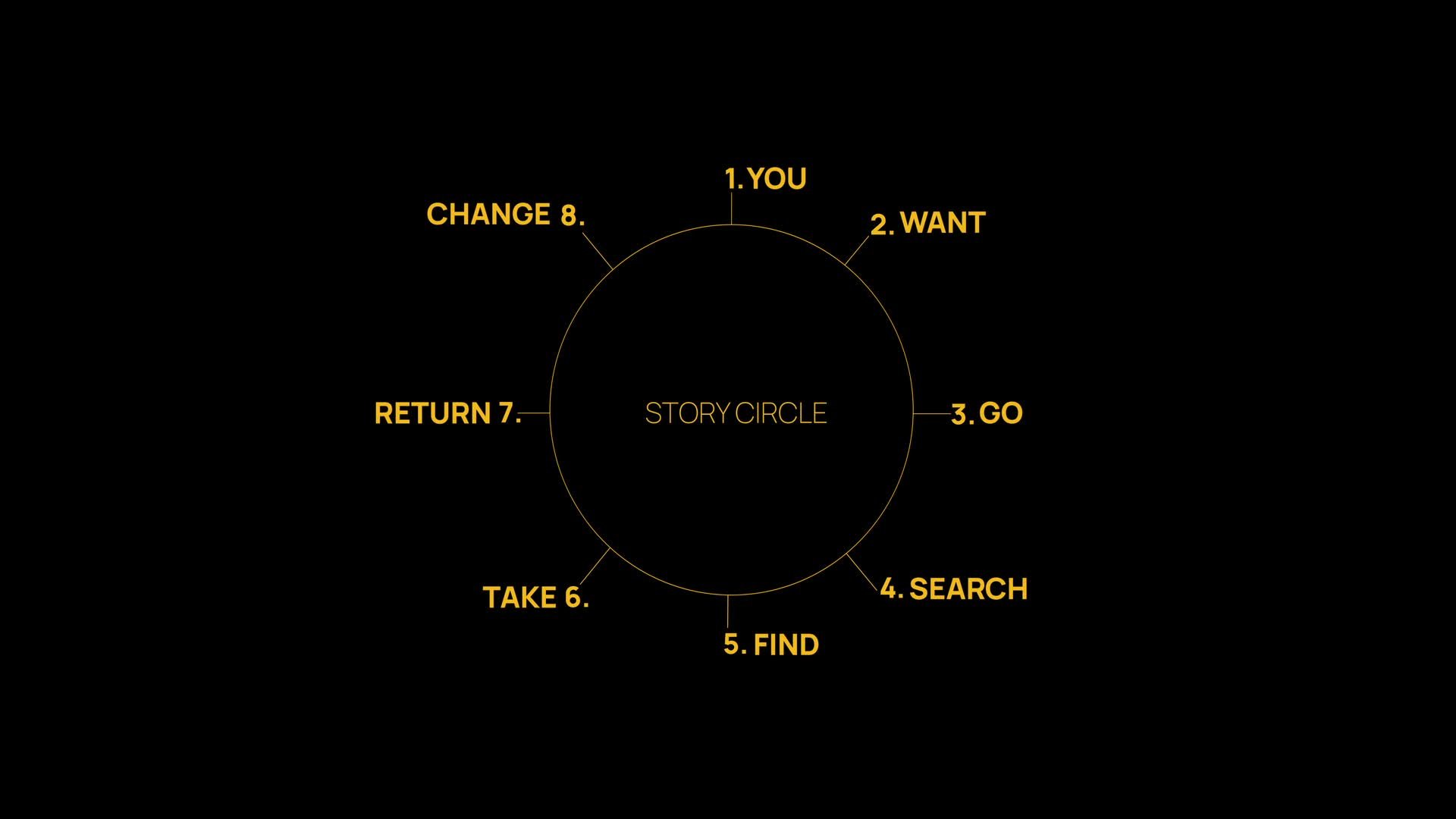
Why the Story Circle Works
The reason we rely on the Story Circle at Passenger is its flexibility and depth.
Each step relates to the step opposite of it. This in turn creates interesting leverage points:
• Want and Take mirror each other (desire and price)
• Go and Return mirror each other (crossing the threshold / coming back across it)
• Search and Change mirror each other (the journey out / the transformation back)
This architecture lets you shape stories in creative ways. You can emphasize certain steps, compress others, or play with the relationships between opposite steps to trigger specific emotional effects.
The Design Behind Great Stories
Here's the truth: there's a design behind effective storytelling.
It's not mysterious. It's not magic. It's not something that only "naturally gifted" storytellers can master.
It's a craft. It's learnable. It's repeatable.
At Passenger, we're constantly exploring how to bend the rules of the Story Circle, how to manipulate these eight steps to get powerful results tailored to each specific story we tell.
Because every founder's story is different and every company's journey is unique. But the framework? The framework is universal.
Your Story Deserves This Framework
If you can take the subject of your story through the Story Circle…clearly establishing who they were, what they wanted, what action they took, how they searched, what they found, what they paid, how they returned, and who they became…you will have the ingredients for a compelling and powerful narrative.
You'll have a story that resonates. A story that lasts. A story that matters.
At Passenger, we help founders and leaders tell their stories with intention and craft. If you're ready to explore your story through this framework, take our assessment to see if we're a good fit.